


Latest News

France backs Denmark, Greenland sovereignty after renewed Trump remarks

France backs Denmark, Greenland sovereignty after renewed Trump remarks France backs Denmark, Greenland sovereignty after renewed Trump remarks
  France on Jan 5 reaffirmed its support for the sovereignty and territorial integrity of Denmark and Greenland, responding to renewed...
Read More...

Over 300 Jewish leaders urge UN to remove official who denied rapes in Hamas attacks

Over 300 Jewish leaders urge UN to remove official who denied rapes in Hamas attacks Over 300 Jewish leaders urge UN to remove official who denied rapes in Hamas attacks
More than 300 rabbis and Jewish leaders, including prominent women’s rights advocates, have called on the United Nations to remove Reem Alsalem,...
Read More...

Warsaw Dialogue for Democracy brings global focus to human rights defenders on the front lines

Warsaw Dialogue for Democracy brings global focus to human rights defenders on the front lines Warsaw Dialogue for Democracy brings global focus to human rights defenders on the front lines
The 13th edition of the Warsaw Dialogue for Democracy, an annual international forum hosted by Poland’s Ministry of Foreign Affairs, convened...
Read More...

Belgium urges accountability for Maduro while stressing respect for international law

Belgium urges accountability for Maduro while stressing respect for international law Belgium urges accountability for Maduro while stressing respect for international law
  Belgian foreign minister Maxime Prévot has called for Venezuelan president Nicolás Maduro to be held accountable, while warning that...
Read More...

Cyprus assumes the Presidency of the Council of the European Union

Cyprus assumes the Presidency of the Council of the European Union Cyprus assumes the Presidency of the Council of the European Union
  On 1 January 2026, Cyprus officially assumed the Presidency of the Council of the European Union, marking a new six-month chapter in...
Read More...

Bulgaria to adopt the euro on 1 January 2026, becoming the 21st member of the euro area

Bulgaria to adopt the euro on 1 January 2026, becoming the 21st member of the euro area Bulgaria to adopt the euro on 1 January 2026, becoming the 21st member of the euro area
  Bulgaria will officially adopt the euro on 1 January 2026, marking a historic step for the country and a further expansion of the European...
Read More...

One in seven young Europeans has dropped out of education, new EU data show

One in seven young Europeans has dropped out of education, new EU data show One in seven young Europeans has dropped out of education, new EU data show
  Nearly 14% of young people across the European Union have dropped out of formal education or training at least once, highlighting stark...
Read More...

Only a quarter of Swiss parliamentarians fully disclose their income

Only a quarter of Swiss parliamentarians fully disclose their income  Only a quarter of Swiss parliamentarians fully disclose their income
  Transparency in Switzerland’s federal parliament remains limited. According to a new report by the watchdog organisation Lobbywatch,...
Read More...

Must Read

Most Popular Stories

VIDEO AND audio news:

Features, views, analysis

business

Latest News

France backs Denmark, Greenland sovereignty after renewed Trump remarks

France backs Denmark, Greenland sovereignty after renewed Trump remarks France backs Denmark, Greenland sovereignty after renewed Trump remarks
  France on Jan 5 reaffirmed its support for the sovereignty and territorial integrity of Denmark and Greenland, responding to renewed...
Read More...

Over 300 Jewish leaders urge UN to remove official who denied rapes in Hamas attacks

Over 300 Jewish leaders urge UN to remove official who denied rapes in Hamas attacks Over 300 Jewish leaders urge UN to remove official who denied rapes in Hamas attacks
More than 300 rabbis and Jewish leaders, including prominent women’s rights advocates, have called on the United Nations to remove Reem Alsalem,...
Read More...

Warsaw Dialogue for Democracy brings global focus to human rights defenders on the front lines

Warsaw Dialogue for Democracy brings global focus to human rights defenders on the front lines Warsaw Dialogue for Democracy brings global focus to human rights defenders on the front lines
The 13th edition of the Warsaw Dialogue for Democracy, an annual international forum hosted by Poland’s Ministry of Foreign Affairs, convened...
Read More...

Belgium urges accountability for Maduro while stressing respect for international law

Belgium urges accountability for Maduro while stressing respect for international law Belgium urges accountability for Maduro while stressing respect for international law
  Belgian foreign minister Maxime Prévot has called for Venezuelan president Nicolás Maduro to be held accountable, while warning that...
Read More...

Cyprus assumes the Presidency of the Council of the European Union

Cyprus assumes the Presidency of the Council of the European Union Cyprus assumes the Presidency of the Council of the European Union
  On 1 January 2026, Cyprus officially assumed the Presidency of the Council of the European Union, marking a new six-month chapter in...
Read More...

Bulgaria to adopt the euro on 1 January 2026, becoming the 21st member of the euro area

Bulgaria to adopt the euro on 1 January 2026, becoming the 21st member of the euro area Bulgaria to adopt the euro on 1 January 2026, becoming the 21st member of the euro area
  Bulgaria will officially adopt the euro on 1 January 2026, marking a historic step for the country and a further expansion of the European...
Read More...

One in seven young Europeans has dropped out of education, new EU data show

One in seven young Europeans has dropped out of education, new EU data show One in seven young Europeans has dropped out of education, new EU data show
  Nearly 14% of young people across the European Union have dropped out of formal education or training at least once, highlighting stark...
Read More...

Only a quarter of Swiss parliamentarians fully disclose their income

Only a quarter of Swiss parliamentarians fully disclose their income  Only a quarter of Swiss parliamentarians fully disclose their income
  Transparency in Switzerland’s federal parliament remains limited. According to a new report by the watchdog organisation Lobbywatch,...
Read More...

Must Read

Most Popular Stories

As 1960 dawned, sub-Saharan Africa braced for historic change: that year, 17 of its countries were destined to gain independence from European colonial

powers.

But six decades on, the continent is mired in many problems. It is struggling to build an economic model that encourages enduring growth, addresses poverty and provides a future for its youth.

Here are some of the key issues:

— Youth 'explosion' —

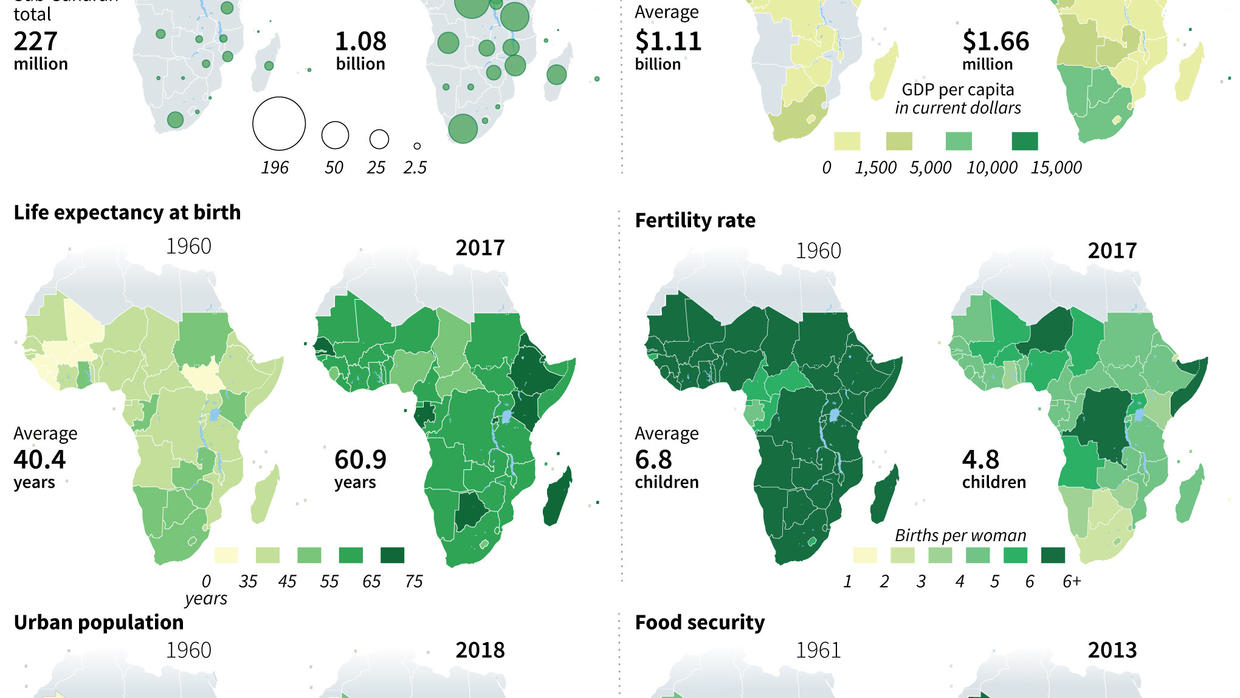
Africa's population grew from 227 million in 1960 to more than one billion in 2018. More than 60 percent are aged under 25, according to the Brookings Institution, a US think tank. 

"The most striking change for me is the increasing reality of disaffected youth... a younger population that is ready to explode at any moment," Cameroonian sociologist Francis Nyamnjoh told AFP.

"They are hungry for political freedoms, they are hungry for economic opportunities and they are hungry for social fulfilment ."

Joblessness is a major peril. Unemployed youths are an easy prey for armed groups, particularly jihadist movements in the Sahel, or may be tempted to risk clandestine emigration, often at the cost of their lives.

The continent's population is expected to double by 2050, led by Nigeria, Ethiopia and Democratic Republic of Congo (DRC).

— Poverty and inequality —

The proportion of Africa's population living below the poverty line —- less than $1.90 (1.7 euros) per day —- fell from 54.7 percent in 1990 to 41.4 percent in 2015, according to the World Bank.

But this average masks enormous differences from one country to another, exemplified by Gabon (3.4 percent of the population in 2017) and Madagascar (77.6 percent in 2012).

"The inequalities between countries are as extreme as in Asia and the inequalities within countries as as high as in Latin America, where landless peasants coexist with huge landowners," said Togolese economist Kako Nubukpo.

Christophe Cottet, an economist at the French Development Agency (AFD), pointed out that inequality in Africa is "very poorly measured."

"There are notably no figures on inequalities of inherited wealth, a key issue in Africa."

— Mega-cities and countryside —

Recent decades have seen the expansion of megacities like Lagos and Kinshasa, typically ringed by shantytowns where people live in extreme poverty, although many medium-sized cities have also grown.

More than 40 percent of Africans now live in urban areas, compared with 14.6 percent in 1960, according to the World Bank. 

In 1960, Cairo and Johannesburg were the only African cities with more than a million residents. Consultants McKinsey and Company estimate that by 2030, about 100 cities will have a million inhabitants, twice as many as in Latin America.

But this urban growth is not necessarily the outcome of a rural exodus, said Cottet.

"The population is rising across Africa as a whole, rather faster in towns than in rural areas," said Cottet.

"There is also the problem of unemployment in towns -- (rural) people have little interest in migrating there."

— Lost decades of growth —

Growth in Africa slammed to a halt in the early 1980s, braked by a debt crisis and structural adjustment policies. It took two decades to recover.

Per-capita GDP, as measured in constant US dollars, shows the up-and-downs, although these figures are official and do not cover Africa's large informal economy: $1,112 in 1960, $1,531 in 1974, $1,166 in 1994 and $1,657 in 2018.

"If you do an assessment over 60 years, something serious happened in Africa, with the loss of 20 years. But there is no denying that what is happening now is more positive," Cottet said.

The IMF's and World Bank's structural adjustment programmes "broke the motors of growth," said Nubukpo, whose book, "L'Urgence Africaine," (The African Emergency) makes the case for a revamped growth model.

The belt-tightening programmes "emphasised the short term, to the detriment of investments in education, health and training."

— New thinking needed —

Africa has a low rate of industrialisation, is heavily dependent on agriculture and its service sector has only recently started to emerge.

"We have not escaped the colonial model. Basically, Africa remains a producer and exporter of raw materials," said Nubukpo. 

He gave the example of cotton: 97 percent of Africa's cotton fibre is exported without processing -- the phase which adds value to raw materials and provides jobs.

For Jean-Joseph Boillot, a researcher attached to the French Institute for International and Strategic Affairs, "Africa is still seeking an economic model of development."

"There is very little development of local industries," he said. 

"This can only be achieved through a very strong approach, of continental industrial protection -- but this is undermined by the great powers in order to pursue free trade.

"The Chinese, the Indians and Westerners want to be able to go on distributing their products."

— Governance problem —

Lack of democracy, transparency and efficient judicial systems are major brakes on African growth, and wealth is concentrated in the hands of a few, said the experts.

Of the 40 states deemed last year to be the most world's most corrupt countries, 20 are in sub-Saharan Africa, according to Transparency International.

"Africa is not developing because it is caught in the trap of private wealth and the top wealth holders are African leaders," said Nubukpo.

"We must promote democracy, free and transparent elections to have legitimate leaders who have the public interest at heart, which we absolutely do not have."

Nyamnjoh also pointed to marginalised groups -- "There should be more room for inclusivity of voices, including voices of the young, voices of women."AFP


deneme