













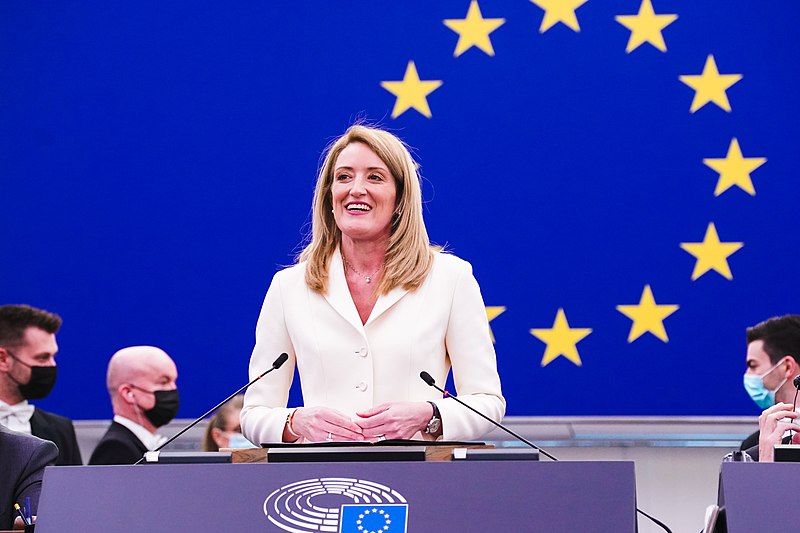
European Parliament President Roberta Metsola has urged EU leaders to modernise the Union’s financial and strategic toolkit, warning that Europe’s next phase
of geopolitical and economic challenges cannot be met with an outdated budget structure.
Speaking at the European Council, Metsola set out a broad agenda spanning the war in the Middle East, Europe’s internal market reforms, and the long-term EU budget negotiations known as the Multiannual Financial Framework (MFF).
Middle East tensions and energy stability
Addressing escalating tensions in the Middle East, Metsola called for a swift and lasting resolution to the conflict, stressing the need to uphold rights, dignity, and stability in the region. She also raised concerns about Iran’s nuclear and ballistic missile programme and the strategic importance of maintaining safe passage through key maritime routes such as the Strait of Hormuz.
Her remarks linked geopolitical instability directly to Europe’s economic resilience, particularly energy prices. She highlighted that recent EU measures on gas storage and diversification of supply have helped stabilise markets and reduce vulnerability to external shocks.
“While we act for today, we cannot abandon what is working for tomorrow. We shouldn’t fix what isn’t broken. Our long-term strategy is working. We need to stay the course,” she said, emphasising continuity in Europe’s energy transition and supply security policies.
### Internal market reforms: “One Europe, One Market”
Turning to the EU’s competitiveness agenda, Metsola welcomed progress on the “One Europe, One Market” roadmap agreed between EU institutions. The initiative aims to deepen the single market, reduce fragmentation, and strengthen Europe’s ability to respond to economic shocks.
However, she stressed that political agreements must now translate into concrete action.
“We are now at the point where commitments need to turn into delivery,” she said, adding that the European Parliament will actively push forward legislative work on priority files. “Europe’s citizens judge Europe on one thing – whether it delivers.”
The EU budget debate: pressure for reform
A central theme of Metsola’s message was the future of the EU’s long-term budget. The Multiannual Financial Framework (MFF) sets spending priorities for several years, covering areas such as agriculture, cohesion policy, research, migration, and defence.
Metsola warned that the next MFF must be fundamentally adapted to today’s geopolitical reality, including war in Ukraine, global economic competition, and energy transition pressures.
She confirmed that the European Parliament is preparing its position ahead of negotiations with the Council. A plenary vote is expected next week, after which formal talks with member states will begin.
The Parliament is expected to push for:
- Greater investment in European competitiveness and industrial policy
- Increased funding for defence and security capabilities
- More flexibility to respond to crises
- Introduction of new EU “own resources” (revenue sources beyond national contributions)
- Safeguards against excessive reliance on future debt
Metsola warned against short-term thinking in budget design, arguing that structural challenges require structural solutions.
“Europe cannot face a new era with an old framework. We cannot keep responding to a changing world with outdated tools. What we need now is a budget that is fit for purpose – ready to deliver where, and when, it matters most,” she said.
Wider EU financial context
The debate over the MFF comes at a time when the EU is already under pressure to balance multiple priorities: supporting Ukraine financially, accelerating the green transition, strengthening defence capabilities, and managing migration.
Recent EU-level financial decisions, including large-scale support packages for Ukraine and expanded investment in energy infrastructure, have intensified calls for a more flexible and larger-scale budget architecture. At the same time, some member states remain cautious about expanding the EU’s fiscal capacity or introducing new common debt mechanisms.
The coming negotiations are expected to test the balance between fiscal restraint and strategic investment, shaping the Union’s political and economic direction for the rest of the decade. Photo by European Parliament from EU, Wikimedia commons.