










Zurich has quietly drawn a new kind of line across the city — one that cannot be seen at first glance, yet carries deep religious and social meaning. Spanning several
neighbourhoods, including Wiedikon, Enge and Wollishofen, the city has established an ‘Eruv’: a symbolic, enclosed public zone covering around 14 square kilometres.
Within this designated area, observant Jews are now able to observe the Sabbath with fewer restrictions. From sundown on Friday until nightfall on Saturday, Jewish law traditionally prohibits carrying objects in public spaces — including prayer books, food, prams or even pushing wheelchairs. The Eruv changes this by symbolically redefining the area as a shared private space, allowing everyday activities that would otherwise be restricted.
The word ‘Eruv’, which comes from Hebrew and can be loosely translated as “mixing” or “merging,” refers to the idea of combining multiple spaces into one. In practical terms, this has been achieved through a carefully planned network of boundaries stretching roughly 18 kilometres and marked by more than 100 individual points.
Most of the Eruv makes use of existing urban infrastructure such as walls, fences and building facades. Where gaps remained, thin nylon threads or discreet posts were installed to complete the symbolic enclosure. According to Cédric Bollag, who initiated the Zurich project, these additions were designed to blend into the cityscape without altering its appearance.
To ensure the Eruv remains valid, a dedicated team inspects the entire structure every week ahead of the Sabbath, repairing any damage if necessary. The current status is published online, allowing residents to check whether the Eruv is approved and functional.
The project was financed entirely by the Jewish community, supported by private donations. Because it involved minor structural installations, a building permit was required, which the community applied for in 2022.
In a statement, organisers described the Eruv as the beginning of a new chapter for Jewish life in Zurich. They also highlighted the cooperation between religious groups and city authorities as an example of openness and mutual trust.
City Councillor Simone Brander echoed this sentiment, saying the project underlines Zurich’s commitment to religious freedom. “The Eruv is a sign of the diversity lived in our city,” she said.
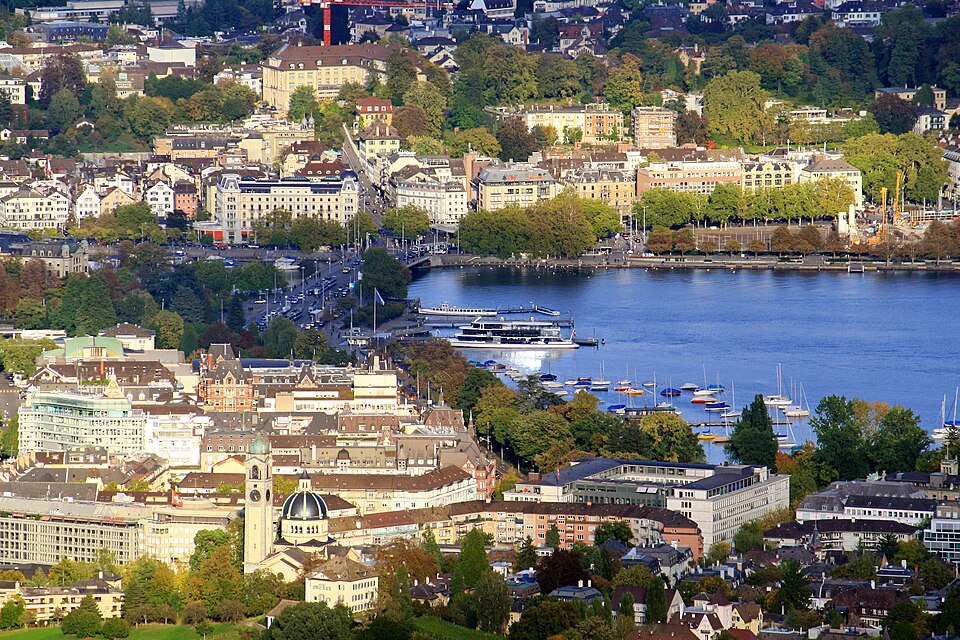
Zurich now joins a number of major European cities — including London, Amsterdam, Vienna and Antwerp — that have already established an Eruv, integrating centuries-old religious traditions into modern urban life. Photo by Roland zh, Wikimedia commons.