








Sir Keir Starmer has announced a major show of military force in the North Atlantic, confirming that a British aircraft carrier strike group will be deployed
towards the Arctic as he warned that Europe is entering a far more dangerous era.
Speaking at the Munich Security Conference, the prime minister said Russia is rapidly rebuilding its armed forces and cautioned that political “easy answers” at home could leave Britain exposed to conflict.
In a pointed intervention, Sir Keir criticised what he described as the extremes of both left and right, strongly implying that a vote for Reform UK or the Green Party would undermine national security. Without naming the parties directly, he accused them of being “soft on Russia and weak on NATO”, arguing that their policies could hasten the return of war to Europe.
“Now we feel the solidity of peace, the very ground that we stand on, softening under our feet,” he told delegates. “It is the job of leaders to be ahead of these seismic shifts. This time must be different.”
Carrier deployment to the High North
As part of that response, Starmer confirmed that the UK will send a carrier strike group to the North Atlantic and “the high north” later this year, led by HMS Prince of Wales and operating alongside US, Canadian and other NATO allies.
The move is widely seen as a signal of resolve in the Arctic region and could involve operations near Greenland amid heightened geopolitical tension involving Russia and China. A carrier strike group typically includes an aircraft carrier, escorting destroyers and frigates, a submarine and a support tanker.
Warning over Russia’s intentions
The prime minister said Moscow’s military ambitions extend well beyond Ukraine, warning that Russia could be ready to threaten the NATO alliance by the end of the decade.
“Even as the war goes on, Russia is rearming, reconvening its armed forces and rebuilding its industrial base,” he said, citing NATO intelligence assessments. A negotiated peace in Ukraine, he added, would not end the danger but could in fact increase it if Russia uses the pause to accelerate rearmament.
Starmer criticised past Western leaders for “looking the other way” until conflict was unavoidable, drawing a stark parallel with Europe on the eve of the First World War. Echoing the words of Sir Edward Grey in 1914, he warned that without resolve, “the lamps would go out across Europe once again”.
A more European NATO
The speech also set out Starmer’s broader foreign policy vision, calling for closer cooperation with Europe and a shift away from what he described as Britain’s “overdependence” on the United States.
“There is no British security without Europe and no European security without Britain,” he said, arguing for a stronger, more coordinated European role within NATO rather than isolationism.
Starmer has already held talks in Munich with French President Emmanuel Macron, German Chancellor Friedrich Merz and Ukrainian leader Volodymyr Zelensky as discussions continue over the future of European defence and the war in Ukraine.
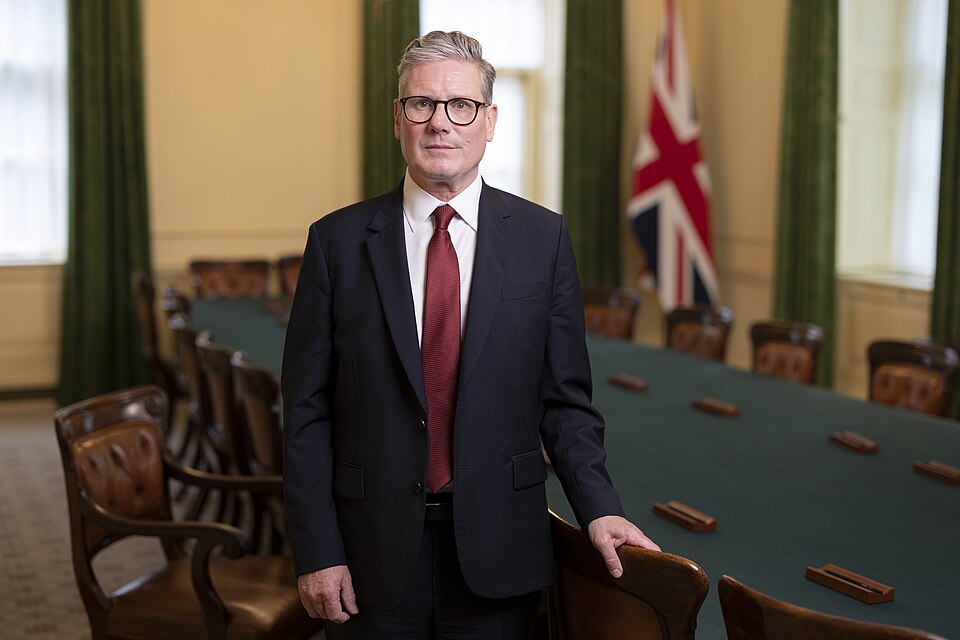
With tensions rising across the continent, the prime minister insisted Britain must be prepared to stand firm. “We are not the Britain of the Brexit years anymore,” he said. “In dangerous times, turning inward doesn’t take back control — it surrenders it.” Photo by Prime Minister’s Office, Wikimedia commons.