










The European Union and Kazakhstan have reinforced their strategic partnership following a high-level meeting in Brussels between European Commission President
Ursula von der Leyen, European Council President António Costa, and President of Kazakhstan Kassym-Jomart Tokayev.
The leaders welcomed a series of new agreements and initiatives aimed at strengthening economic cooperation, improving connectivity, enhancing trade opportunities, and advancing collaboration on critical raw materials. The visit underscores the growing importance of EU-Kazakhstan relations and builds on the momentum generated by the first EU-Central Asia Summit held in Samarkand in 2025.
President Ursula von der Leyen highlighted Kazakhstan’s pivotal role as a bridge between Europe and Asia.
President von der Leyen said: “Kazakhstan is a global gateway, and so is Central Asia. The visit of President Tokayev today signals the growing partnership between the European Union and Kazakhstan. We are ready to turn that gateway into a pathway for jobs, business opportunities and common prosperity. Following the success of our first-ever EU-Central Asia Summit last year, our Global Gateway strategy will continue bringing our regions closer together.”
Boosting air connectivity and market access
A key milestone of the visit was the signing of a Horizontal Aviation Agreement that will expand air connectivity between Kazakhstan and the European Union.
The agreement grants all EU airlines the right to operate flights between Kazakhstan and any of the 17 EU Member States that currently maintain bilateral air services agreements with the country. This will create a more competitive aviation market, provide greater flexibility for carriers, and offer passengers increased travel options.
The signing marks the successful conclusion of negotiations that have spanned more than two decades.
Advancing the Trans-Caspian transport corridor
As part of the EU’s Global Gateway initiative, the European Investment Bank and Kazakhstan’s National Road Company signed a framework loan agreement worth up to €150 million.
Backed by an EU guarantee, the financing will support upgrades to key road infrastructure along the Trans-Caspian Transport Corridor, a flagship project designed to strengthen direct East-West trade routes and improve regional connectivity.
The agreement follows the EU’s previous support for the modernization of Aktau Port, further reinforcing Kazakhstan’s role as a critical transport hub linking Europe and Asia.
Strengthening cooperation on critical raw materials
The European Bank for Reconstruction and Development and the Government of Kazakhstan signed a Memorandum of Understanding to support a feasibility study for the construction of an internationally accredited chemical-analytical laboratory in Astana.
The facility will play an important role in testing and certifying critical raw materials, supporting international quality standards and helping to strengthen supply chain resilience.
The initiative reflects the EU’s commitment to deepening cooperation with Kazakhstan in the strategic critical raw materials sector and forms part of the broader Global Gateway investment agenda.
Progress on visa facilitation
The European Commission and Kazakhstan have successfully concluded negotiations on a Visa Facilitation Agreement and a Readmission Agreement.
Once formally adopted, the Visa Facilitation Agreement will simplify procedures for Kazakh citizens applying for short-stay visas to the European Union, encouraging greater people-to-people exchanges, tourism, education, and business travel.
The Readmission Agreement will support the effective implementation of EU migration policies and reflects the strong cooperation between both sides, including efforts to prevent the circumvention of EU sanctions.
Expanding business and investment opportunities
On the sidelines of the leaders’ meeting, European Commissioner for Trade and Economic Security Maroš Šefčovič and President Tokayev co-chaired an EU-Kazakhstan Business Roundtable attended by leading European companies interested in expanding their presence in Kazakhstan.
A significant outcome of the event was an agreement for Kazakhstan to purchase up to 50 Airbus aircraft, highlighting growing commercial ties and the opportunities created by the EU’s global partnerships.
A strategic partnership for the future
Relations between the European Union and Kazakhstan are anchored in the Enhanced Partnership and Cooperation Agreement (EPCA), which entered into force in 2020. Today, the EU remains Kazakhstan’s largest trade and investment partner, accounting for approximately one-third of the country’s external trade.
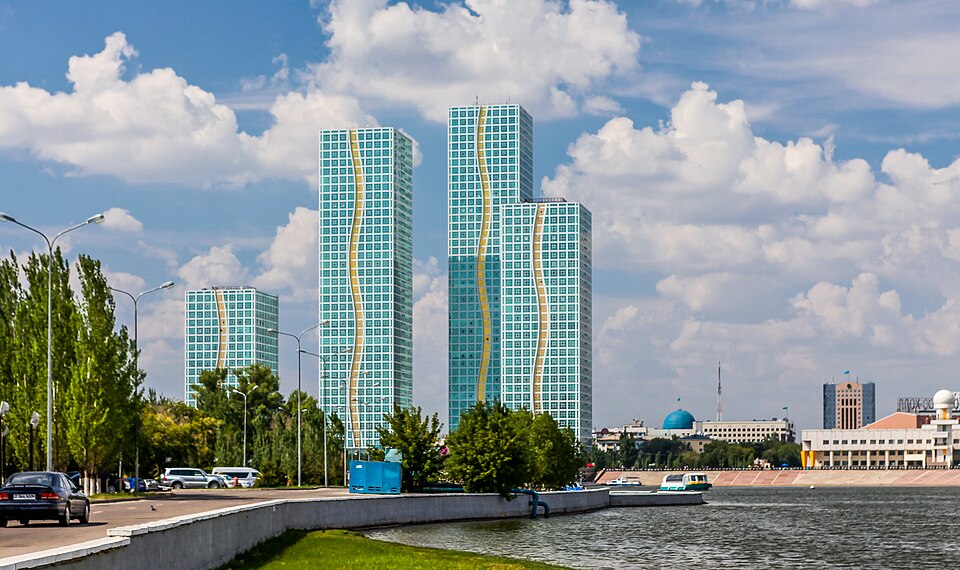
The Brussels meeting further advances the strategic partnership established between the European Union and the five Central Asian republics at the inaugural EU-Central Asia Summit in 2025. It also reinforces the EU’s commitment to its €12 billion Global Gateway investment package supporting transport, digital connectivity, energy, water, climate action, and critical raw materials across the region. Photo by Ninaras, Wikimedia commons.