









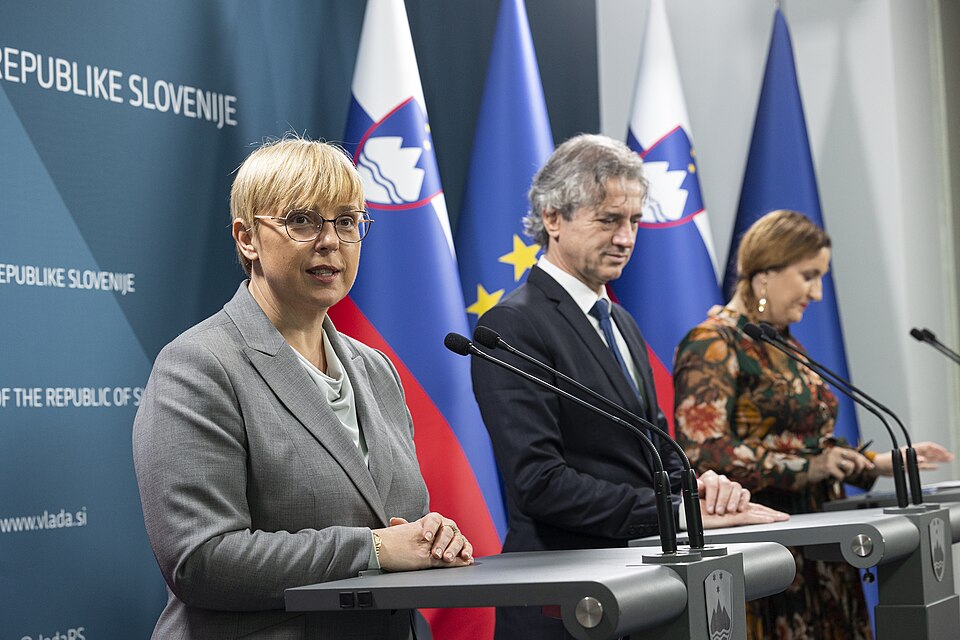
President Nataša Pirc Musar plans to call Slovenia’s next parliamentary election for 22 March 2026, with the decision to be formalised in early January. The announcement comes
as the country braces for a closely fought contest, with opinion polls pointing to a fragmented political field and a potentially difficult coalition-building process.
Slovenia will enter a pivotal election year in 2026, as the March general election will be followed by local elections in November. Speaking at a New Year’s reception for the media on 22 December, Pirc Musar confirmed she had settled on a single date after previously floating three possible options. She said the official election writs would be issued at the beginning of January.
By law, parliamentary elections must be held between 135 and 75 days before the fourth anniversary of the first sitting of the current National Assembly. Once the writs are issued, the vote must take place within 60 to 90 days.
Fragmented political landscape
The campaign is expected to unfold against a complex backdrop of international developments and sensitive domestic issues, including ongoing debates over Roma integration following a fatal incident involving a Roma suspect. Public tensions rose after the prime suspect in the case was released from custody, although a new suspect has since been detained.
Court and criminal proceedings involving senior politicians could also shape the campaign. These include cases linked to Prime Minister Robert Golob as well as several prominent opposition figures.
Since the last general election, when only five parties won parliamentary seats, Slovenia’s political landscape has become increasingly fragmented. New parties have emerged across the political spectrum, and several groups with more radical platforms have announced plans to contest the vote.
Opinion polls conducted in recent months consistently show the opposition Slovenian Democratic Party (SDS) as the strongest force, with the governing Freedom Movement in second place. The gap between the two has narrowed, according to the latest surveys.
Parties’ recent ratings
A poll commissioned by public broadcaster RTV Slovenija and published on 21 December found that, if elections were held now, the SDS would secure 21.1% of the vote, slightly down from 21.4% in November. The Freedom Movement followed with 17.5%, nearly one percentage point higher than a month earlier.
The Social Democrats, a junior coalition partner, ranked third, ahead of the junior opposition party New Slovenia (NSi).
Most parties recorded only marginal changes in support. The anti-establishment Truth party remained steady at 4.2%, placing fifth despite not currently being represented in parliament.
The Left, the only other parliamentary party, plans to run jointly with the Green party Vesna. Together they polled 3.7%, slightly below the Left’s standalone result in November.
Among non-parliamentary contenders, the Democrats registered 3.5%, We, the Socialists! 3%, and Renaissance 2.4%, underscoring the increasingly crowded field ahead of the March vote. Photo by Vlada Republike Slovenije from Ljubljana, Slovenia, Wikimedia commons.