












The presence of women in science and engineering across the European Union continues to grow, reaching a new milestone in 2024. According to the
latest data, 7.9 million women are now working as scientists and engineers in the EU — more than double the figure recorded in 2008.
The upward trend has been steady over the past decade and a half. In 2008, around 3.4 million women were employed in these professions. By 2014, that number had climbed to 5.2 million, and growth has continued since, reflecting gradual progress toward greater gender balance in highly skilled fields.
In 2024, women accounted for 40.5% of all scientists and engineers across the EU economy. Their representation was strongest in knowledge-intensive services, where women made up 45.1% of the workforce, closely followed by the broader services sector at 45.0%. The picture was less balanced in manufacturing, where women represented just 22.4% of scientists and engineers, and in other economic activities, where the share stood at 23.6%.
The proportion of female scientists and engineers varies significantly between EU countries. Latvia topped the ranking in 2024, with women making up 50.9% of the sector. Denmark (48.8%), Estonia (47.9%), Spain (47.6%), and both Bulgaria and Ireland (47.3%) also reported near-parity levels.
At the other end of the scale, Finland recorded the lowest share of women in science and engineering roles at 30.7%. Hungary (31.7%), Luxembourg (32.4%), Slovakia (33.6%) and Germany (34.6%) also fell well below the EU average.
Regional data reveal even sharper contrasts. At NUTS 1 level, women formed the majority of scientists and engineers in 11 EU regions. Spain led with four regions — Canarias (58.8%), Centro (52.5%), Noroeste (52.4%) and Sur (50.3%). Portugal followed with strong female representation in the Região Autónoma dos Açores (57.3%) and Madeira (56.4%). Other regions with a female majority included Makroregion Centralny and Makroregion Wschodni in Poland, Severna i yugoiztochna in Bulgaria, Norra Sverige in Sweden, and Latvia as a whole.
Meanwhile, the lowest regional shares were recorded in Közép-Magyarország in Hungary (30.0%), Manner-Suomi in Finland (30.7%), Sud in Italy (31.1%) and several German regions, including Rheinland-Pfalz, Baden-Württemberg and Hessen.
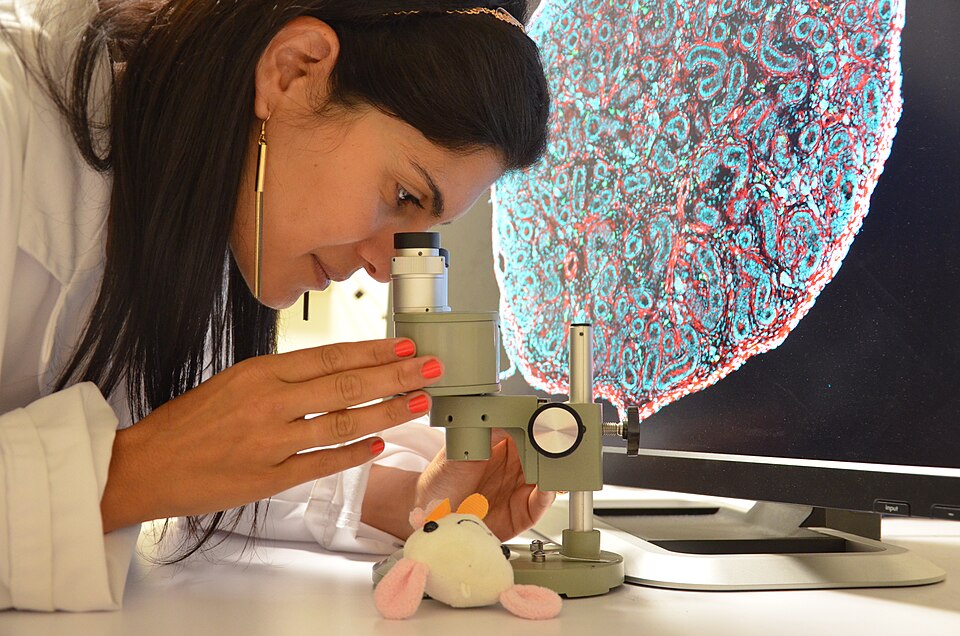
The publication of these figures coincides with the 11th International Day of Women and Girls in Science, marked each year on 11 February, highlighting both the progress made and the challenges that remain in achieving full gender equality in scientific and technical careers. Photo by Mossadegh-keller and Mailfert, Wiimedia commons.