










First anniversary of Assad’s downfall: joint statement by High Representative for Foreign Affairs and Security Policy Kallas and Commissioners Šuica and Lahbib
One year ago, the fall of the Assad regime marked the end of decades of a brutal dictatorship, responsible for the death, disappearance and displacement of hundreds of
thousands of people and for the destruction of large parts of the country, with disastrous consequences on the overall fabric of the Syrian society. Its fall gave the Syrian people a historical opportunity to engage in a political, economic, and social transition.
In this new context, the EU has stood with Syria and its people through every stage of their challenging transition. In February, it suspended key economic sanctions, and in May, it fully lifted economic sanctions to support Syria's recovery. In March, the EU hosted the Brussels IX Conference on Syria, where it cemented its role as the leading donor and, together with Member States, pledged €3.4 billion to address the huge humanitarian and socio-economic needs of Syria and the region. In November, the EU organised jointly with the Syrian civil society and the Syrian transitional authorities, the first ever ‘Day of Dialogue' in Syria, gathering more than 300 representatives to discuss how to better support the ongoing transition.
The EU welcomes the commitments of the transitional authorities towards a peaceful and inclusive transition, as well as the progress made since December 2024, such as the signing of the Constitutional Declaration, and the establishment of new institutions, including the two new commissions on transitional justice and the missing. The ongoing cooperation with international partners, including the United Nations, will allow the international community to provide its support to the ongoing transition, so that the commitments and key principles enshrined in the Constitutional Declaration are fully implemented and translated into action. Principled humanitarian access and protection remain essential to address the continued humanitarian needs of more than 16.5 million Syrians across the country.
At the same time, the EU is deeply concerned by the waves of violence that have unfolded since March in various parts of the country. There can be no peace and stability in Syria without a process of national dialogue, reconciliation, and transitional justice, reinforced by the consolidation of state institutions and genuine security sector reforms with the objective to guarantee that all Syrians from all ethnic and religious backgrounds without discrimination are protected and represented by the authorities, and involved in the formation of a united, inclusive and democratic Syria. The EU will continue to support these efforts.
The EU also condemns any foreign military actions and attempts to undermine Syria's stability and prospects for a peaceful transition. We reiterate our call to respect Syria's sovereignty, unity, independence and territorial integrity and avoid any actions that would undermine the respect for the UN Security Council resolution 497 (1981).
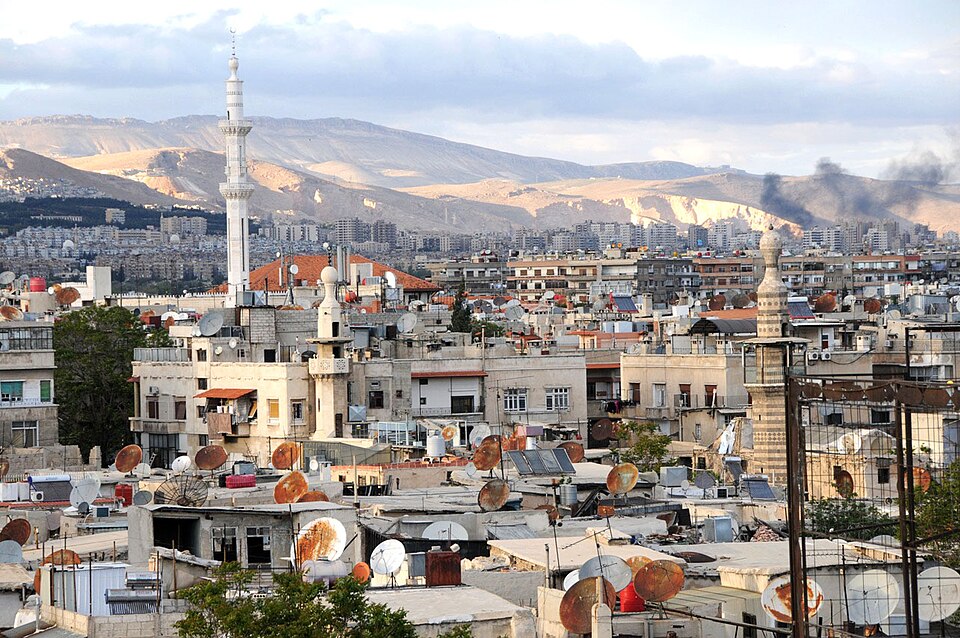
After years of conflict and division, Syria faces immense challenges, but also tremendous opportunities, that can lead the country towards the brighter future its people envision and deserve. Over the past 14 years, the EU and its Member States have mobilised over €38 billion in humanitarian, development, economic and stabilisation assistance, supporting Syrians both inside the country and across the region. The EU will continue to support Syrians' aspirations for a stable, prosperous and democratic country. It looks forward to working in a spirit of partnership to address the shared challenges facing Syria, the region and Europe. Photo by anjči from London, UK, Wikimedia commons.