















A coalition of European lawmakers is stepping up pressure on Brussels to halt trade with Israeli settlements, reflecting widening divisions within the European Union over its
economic ties with Israel and the occupied Palestinian territories.
According to reporting by De Standaard, 57 Members of the European Parliament (MEPs) have formally urged the European Commission to impose a comprehensive ban on goods produced in Israeli settlements. The proposal targets a wide range of imports, from agricultural products such as dates, avocados, mangoes and olives to wine and manufactured goods including plastics, carpets and bathroom fittings.
Among those backing the initiative are several Flemish politicians, including Hilde Vautmans, Wouter Beke, Kathleen Van Brempt and Sara Matthieu.
Vautmans, who sits on the European Parliament’s Foreign Affairs Committee, argued that allowing such goods into the EU market amounts to tacit approval of alleged human rights violations. “These are products linked to serious breaches of international law, and they should not be circulating freely in Europe,” she said.
Mounting pressure after stalled EU talks
The call comes shortly after a meeting of EU foreign ministers on 21 April failed to produce a consensus on suspending the trade pillar of the EU-Israel Association Agreement—the legal framework governing economic relations between the EU and Israel. The agreement grants preferential trade terms, making the EU Israel’s largest trading partner.
While unanimity among member states proved elusive, several countries—including France and Sweden—have since advocated for targeted restrictions on settlement goods, with some officials floating the possibility of a full import ban. Italy has signaled it may be open to similar measures.
Legal and political backdrop
The debate has intensified following a 2024 advisory opinion by the International Court of Justice, which stated that countries should avoid trade relationships that help sustain what it described as an illegal situation in occupied territories. Though non-binding, the opinion has added legal weight to calls for stricter EU action.
Several member states—including Netherlands, Spain, Slovenia, Ireland and Belgium—have already taken steps toward national-level restrictions on settlement imports. However, implementation remains uneven. Belgium, for instance, is still drafting the technical framework required to enforce such a ban.
A delicate EU–Israel relationship
The dispute highlights broader tensions in EU–Israel relations. The European Union maintains close economic, scientific and political ties with Israel, cooperating on trade, research and security. At the same time, Brussels has consistently opposed Israeli settlement expansion, viewing it as incompatible with international law and a major obstacle to a two-state solution.
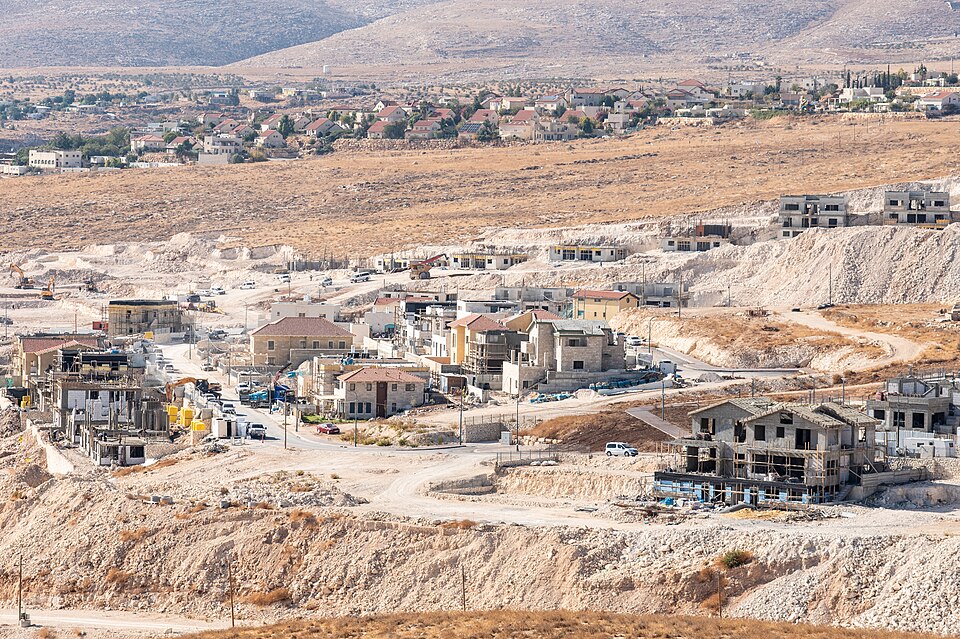
This dual-track approach—strong partnership alongside political criticism—has become increasingly difficult to sustain as the conflict and humanitarian concerns draw sharper scrutiny within Europe. Calls for trade restrictions on settlement goods reflect a growing willingness among some EU policymakers to translate longstanding political positions into concrete economic measures. Photo by Trocaire, Wikimedia commons.