











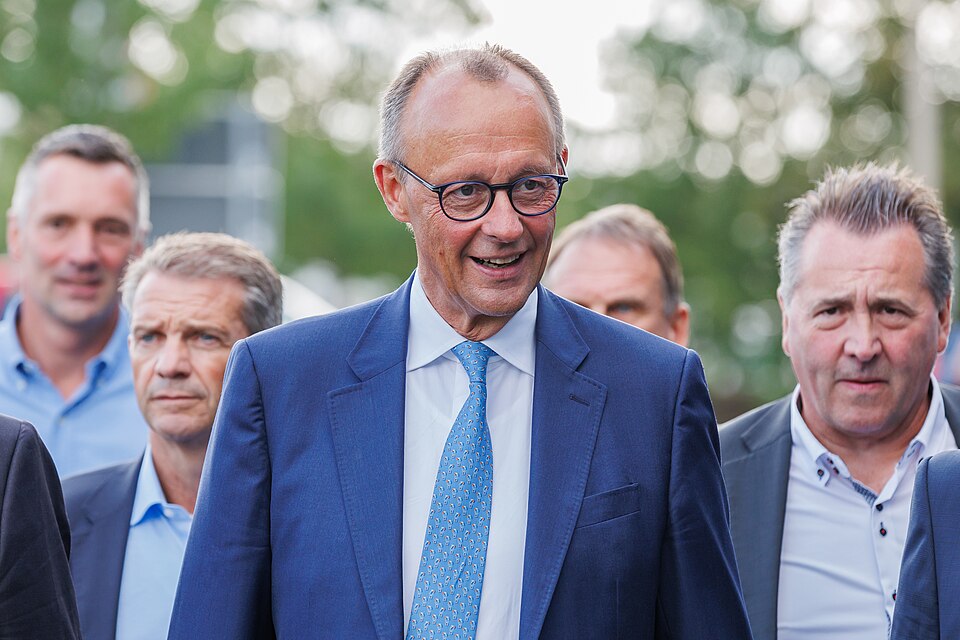
German Chancellor Friedrich Merz has pledged to fight for the survival of Europe’s flagship next-generation fighter jet programme, warning that both Germany’s industrial future
and broader European defence cooperation are at stake.
Speaking at a conference hosted by the Frankfurter Allgemeine Zeitung, Merz said his government is working intensively to rescue the troubled Future Combat Air System (FCAS), a joint initiative between Germany, France, and Spain.
“The future of German industry is now at stake,” Merz stated, emphasizing the deep ties between the country’s industrial base and its defence sector. He added that he would “fight until the very last moment” to preserve key European defence projects such as FCAS.
The programme, valued at roughly €100 billion, aims to develop a cutting-edge air combat system to replace current fighter jets by the 2040s. However, it has been thrown into uncertainty due to escalating tensions between France’s Dassault Aviation and Airbus, which represents German and Spanish interests. The dispute centers on leadership, intellectual property rights, and workshare within the project.
In an effort to break the deadlock, Berlin and Paris have appointed two high-level mediators—one from each country—tasked with proposing a path forward by the end of next month.
Beyond FCAS, Merz also signaled a broader strategic push to reinforce Germany’s role in European defence. He confirmed that the German government plans to acquire a significant minority stake in KNDS, the Franco-German manufacturer of Leopard battle tanks. The move is intended to maintain national influence as the company prepares for a potential stock market listing later this year, with an estimated valuation of €20–25 billion.
Earlier reports indicated Berlin could seek a stake of at least 25.1%, underscoring the government’s determination to retain a blocking minority in strategically important defence firms.
Context: Franco-German military cooperation
The FCAS programme is not just an industrial project—it is a cornerstone of long-standing defence cooperation between France and Germany, often seen as the driving force behind European strategic autonomy.
Since the end of World War II, both countries have steadily deepened military ties, from joint brigades to shared procurement initiatives. One of the most notable examples is KNDS, formed through the merger of Germany’s Krauss-Maffei Wegmann and France’s Nexter, symbolizing cross-border integration in land systems.
Another major joint effort is the Main Ground Combat System (MGCS), a future tank project intended to replace Germany’s Leopard 2 and France’s Leclerc tanks. Like FCAS, MGCS has also faced delays and disagreements over industrial roles.
Despite these challenges, Franco-German cooperation remains essential for Europe’s defence ambitions. The two countries together account for a significant share of EU defence spending and technological capacity. However, recurring industrial rivalries, differing strategic cultures, and competition between national champions continue to test the partnership.
The outcome of the FCAS dispute is therefore being closely watched—not only as a question of one programme’s survival, but as a broader indicator of whether Europe can successfully build a unified and competitive defence industry. Photo by Steffen Prößdorf, Wikimedia commons.