








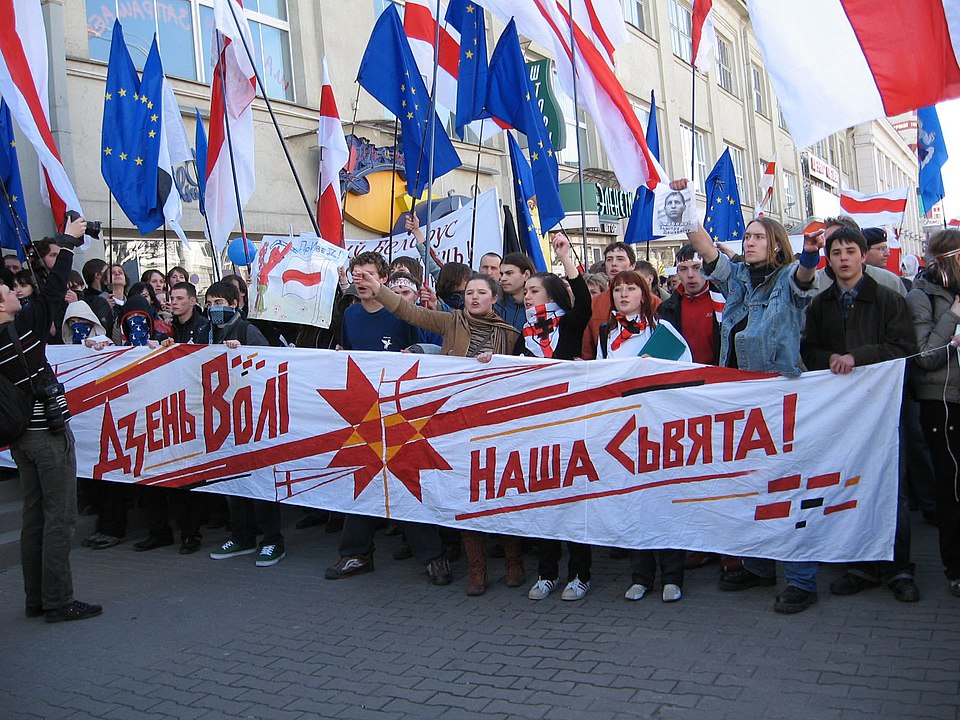
March 25 — known as Freedom Day — remains the most powerful symbol of resistance for Belarusian democratic movements. Though banned and suppressed inside Belarus,
The march in the Polish capital culminated in a large evening rally and concert at Castle Square, drawing activists, diaspora communities, and international supporters. Among the key figures present was Belarusian opposition leader Sviatlana Tsikhanouskaya, who addressed the crowd with a message of resilience and unity.
“Freedom Day is a symbol of our perseverance and our constant struggle for liberty,” Tsikhanouskaya said. “For decades, Belarusians have taken to the streets on this day — even when the regime tries to erase it.”
Freedom Day commemorates March 25, 1918, when the Belarusian People’s Republic — the country’s first modern attempt at independence — was declared. While democratic circles recognize this as the true birth of Belarusian statehood, the government of Alexander Lukashenko promotes July 3 as the official Independence Day, marking the Soviet Red Army’s recapture of Minsk in 1944.
Critics argue that this date reflects Soviet legacy rather than genuine independence. Tsikhanouskaya was blunt in her assessment, stating that Lukashenko’s rule rejects Belarusian identity and democratic values. She also pointed to the symbolic timing of his diplomatic engagements abroad, contrasting them with the grassroots celebrations of Belarusians worldwide.
Beyond commemoration, the gatherings in Poland carried a clear political message: Belarusians are fighting not only for symbolic recognition but for fundamental rights. Demonstrators waved the historic white-red-white flag — now banned in Belarus — and called for the release of political prisoners.
According to the Viasna Human Rights Center, hundreds of political prisoners remain detained under the current regime, many subjected to harsh conditions and denied fair trials.
The Broader Fight for Democracy in Belarus
The significance of Freedom Day has only grown since the mass protests of 2020, widely seen as the largest challenge to Lukashenko’s rule. After a disputed presidential election, millions of Belarusians mobilized, demanding fair elections, freedom of speech, and an end to political repression.
The government’s response was swift and severe: widespread arrests, media crackdowns, and the dismantling of civil society organizations. Independent journalism was nearly eliminated, while activists and opposition figures were forced into exile or imprisoned.
Today, the Belarusian democratic movement operates largely from abroad — with Poland, Lithuania, and other neighboring countries serving as hubs for exiled leaders and activists. Events like the Freedom Day march in Warsaw are not only symbolic but strategic: they keep international attention focused on Belarus and reinforce solidarity with Ukraine and other nations resisting authoritarian influence.
Tsikhanouskaya emphasized that global awareness remains crucial. “Belarusians are not the regime. We are a nation that continues to fight for freedom,” she said, urging Europeans to stand in solidarity.
Why it matters
Freedom Day is no longer just a historical anniversary — it is an ongoing act of defiance. Each year, despite repression at home, Belarusians continue to assert their identity, demand democratic change, and remind the world that their struggle is far from over.
The marches in Warsaw and beyond show that even in exile, the movement remains alive — and determined. Photo by Cesco, Wikimedia commons.