














Belgium has taken a significant step toward dismantling its Senate, as lawmakers advance a long-debated institutional reform that could reshape the country’s federal structure.
On Monday, the Senate’s Institutional Affairs Committee approved a proposal to revise Article 195 of the Constitution—an essential legal step required before the upper chamber itself can be abolished. While procedural in nature, the vote marks the first of eight stages needed to complete the reform.
The proposal, introduced by parties within the federal governing coalition, received backing from several opposition groups, reflecting a rare moment of cross-party alignment in Belgium’s often fragmented political landscape. However, not all were convinced: socialist representatives opposed the move, while others voiced concerns about minority representation, particularly for the German-speaking community.
Concerns over representation
The delay of an earlier vote in February highlighted the sensitivity of the issue. Critics within the majority coalition questioned how the German-speaking minority would be represented if the Senate—currently structured to include regional delegates—were to disappear.
Prime Minister Bart De Wever acknowledged these concerns, stressing that safeguards must be found before the reform is finalized. He argued that abolishing the Senate does not mean weakening democratic participation but rather offers an opportunity to redesign it in a more efficient way.
### A Gradual Shift Away from Bicameralism
Belgium’s federal parliament has been bicameral since the country’s independence in 1831, composed of the Chamber of Representatives and the Senate. Over decades of state reforms, however, the balance of power has shifted decisively.
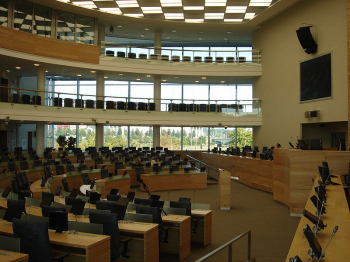
Today, the Chamber of Representatives handles nearly all legislative work, including passing laws, approving budgets, and scrutinizing the government. The Senate, by contrast, plays a largely symbolic and consultative role, primarily serving as a forum for dialogue between Belgium’s regions and language communities.
Supporters of abolition argue that maintaining the Senate is no longer justified given its limited powers and operational costs. If the reform process continues successfully, the upper chamber could disappear entirely by 2029, effectively turning Belgium into a unicameral parliamentary system.
What happens next
The constitutional revision will now move to a plenary vote in the Senate, where it must secure a two-thirds majority—an often challenging threshold in Belgium’s divided political environment. Even if approved, several additional steps remain before the Senate can formally be abolished.
Belgium’s complex political landscape
The push to eliminate the Senate comes at a time when Belgium is grappling with broader questions about governance, efficiency, and national cohesion.
Belgian politics is famously complex, shaped by linguistic divisions between Dutch-speaking Flanders, French-speaking Wallonia, and a small German-speaking community. Governments are almost always coalitions, often involving multiple parties across ideological and regional lines, which can make decision-making slow and compromise-heavy.
Recent years have seen increasing support for institutional reform, particularly in Flanders, where some parties advocate for greater regional autonomy or even a confederal model. At the same time, federal institutions are under pressure to become more streamlined and cost-effective.
Against this backdrop, abolishing the Senate is seen by many as a pragmatic step—less about ideology and more about modernizing a system that has evolved incrementally over nearly two centuries.
Whether this reform will strengthen Belgium’s governance or deepen existing tensions remains an open question. What is clear, however, is that the country is once again testing the limits of its uniquely intricate political system. Photo by User:Asterion, Wikimedia commons.