









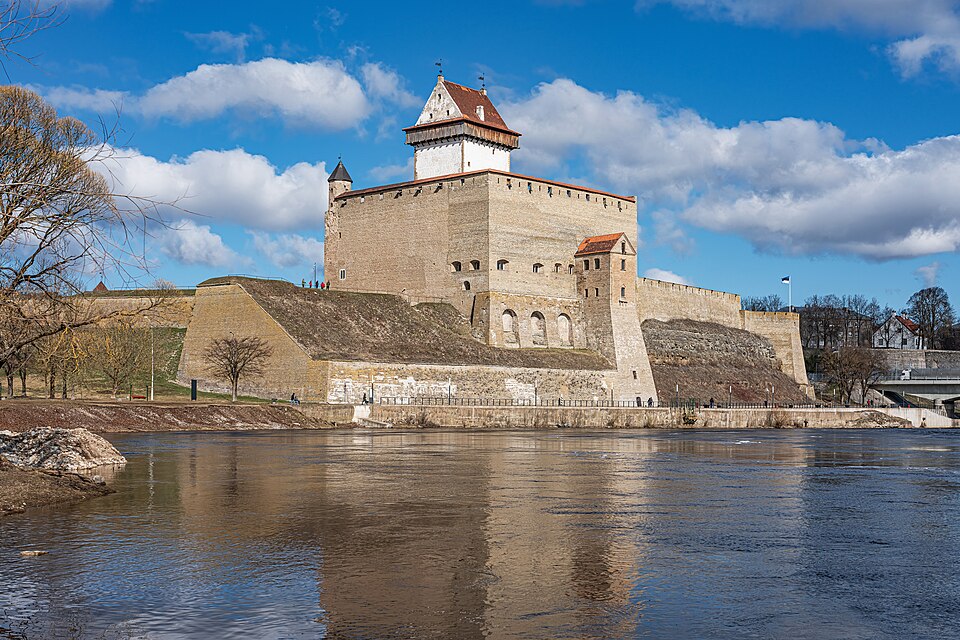
Foreign journalists continue to descend on the Estonian border city of Narva, chasing a story that locals insist simply does not exist: a supposed “Narva People’s Republic.”
What began as a fringe online rumor has quickly spiraled into an international media spectacle. The claim — amplified by a small, obscure social media group — suggested the emergence of a separatist movement in the predominantly Russian-speaking city. Despite a lack of evidence, the story has proven irresistible to foreign outlets eager to explore tensions on the European Union’s eastern frontier.
The Estonian counter-disinformation initiative Propastop was among the first to flag the online activity. According to the group, the so-called “Narva People’s Republic” page rapidly attracted over a thousand followers, raising concerns about coordinated influence operations rather than any genuine grassroots movement.
For Narva’s residents, however, the attention has been both baffling and exhausting.
Mayor Katri Raik says she has reached her limit. After repeating the same message to countless reporters, she has now opted out of interviews altogether.
“No one here knows anything about this ‘people’s republic,’” Raik said. “There is no such thing here and there won’t be.”
Despite this, camera crews and correspondents continue to gather near the Narva border crossing — one of the European Union’s most symbolically charged frontiers, facing Russia across the Narva River.
Among them was Lithuanian journalist Marius Zaremba, who admitted the story influenced his trip.
“We didn’t find anything,” he said. “People here mostly find the topic amusing — some hadn’t even heard of it.”
Instead, Zaremba noted, the real story lies elsewhere: in the daily lives of Narva’s residents and their perspectives on Russia, Estonia, and the ongoing war in Ukraine.
A familiar pattern of disinformation
The episode bears hallmarks of broader Russian disinformation strategies seen elsewhere in the region. Similar narratives — often involving alleged “people’s republics” — have previously been used to justify political or military interventions, most notably in eastern Ukraine in 2014.
While there is no indication of any real separatist movement in Narva, experts warn that such narratives can be deliberately seeded online to test reactions, create confusion, or attract international attention.
Narva, where a majority of residents are Russian speakers, has long been a focal point for Kremlin-linked messaging. Russian state media has historically portrayed the city as culturally and politically divided from the rest of Estonia — a narrative Estonian authorities strongly reject.
In this context, the sudden emergence of a “Narva People’s Republic” storyline appears less like a grassroots initiative and more like a classic information operation: low-cost, high-visibility, and designed to exploit existing geopolitical sensitivities.
Locals shrug, media keeps coming
On the ground, the reaction is far more subdued than the headlines suggest.
Local journalist and fixer Aleksei Ivanov described the situation with a hint of disbelief.
“I don’t even know what to call it — a project, a phenomenon, or just someone’s joke,” he said. “People here aren’t taking it seriously.”
Still, the steady stream of international coverage has had some side effects. Local guides and tourism operators have seen increased demand as foreign crews seek help navigating the city and arranging interviews.
Major outlets, including Deutsche Welle and Bild, have already reported from Narva, with more journalists expected in the coming days.
Between reality and narrative
The disconnect between perception and reality in Narva highlights a growing challenge in the digital age: how quickly fringe online content can shape global narratives.
In this case, a rumor with little local traction has managed to capture international attention — fueled not by events on the ground, but by the dynamics of modern information warfare.
For Narva’s residents, the situation remains unchanged. Life continues as usual in the quiet border city — even as, just beyond the camera lens, a story that doesn’t exist keeps making headlines. Photo by A.Savin, Wikimedia commons.