











Poland’s Foreign Minister Radoslaw Sikorski has called for a more balanced leadership of Europe, arguing that Germany and France are now “too
weak” to govern the continent alone. In an interview with German weekly ‘Der Spiegel’, Sikorski emphasized the need for both Western and Eastern European countries to shape the European Union’s future.
“Germany and France are too weak today to govern Europe. Even together they do not have a blocking minority,” Sikorski said. He stressed that Poland, the largest of the ten countries that joined the EU in 2004 and one of the world’s 20 biggest economies, is ready to play a stronger role in balancing power within the bloc. Invoking Pope John Paul II, Sikorski remarked, “Europe must breathe with two lungs, western and eastern.”
Poland joins key EU dialogue
Sikorski expressed gratitude to German Foreign Ministry official Johann Wadephul for inviting Warsaw into the E5 format, which includes Germany, France, Italy, and Britain. The inclusion marks a significant step in amplifying Central and Eastern European perspectives in EU decision-making.
Polish-German relations improving
Addressing historical tensions with Germany, Sikorski rejected claims that Polish-German relations have worsened since Poland’s government change in 2023. “It is much better. The government in Warsaw no longer sends you any bills,” he told German readers.
He highlighted ongoing efforts to strengthen ties, including a planned monument in Berlin for Polish victims of World War II and a future German-Polish House. Sikorski stressed that reconciliation should be grounded in a complete understanding of history, noting gaps in German historical memory.
On the sensitive issue of wartime reparations, Sikorski acknowledged the outcomes of the Potsdam Conference, under which Poland was to receive compensation via reparations awarded to the Soviet Union. “These were never paid to us. You could say they were stolen from us,” he said, pointing out that tens of thousands of German-occupied Poland’s victims are still alive and deserve a symbolic act of moral responsibility.
Security, Russia, and Ukraine
On security, Sikorski highlighted joint Polish-German concerns over the Baltic Sea region and the threat posed by Russian ballistic missiles stationed in Kaliningrad. He revealed that Poland’s defense ministry has shared a list of potential military projects with Berlin, emphasizing that strong German engagement would reinforce Poland’s reliance not just on NATO but also on bilateral friendship.
Sikorski also defended Germany as a reliable partner amid rising anti-German rhetoric from Poland’s nationalist opposition. He praised his government’s efforts to counter war fatigue and support Ukrainian refugees, citing successful fundraising for power generators sent to Ukraine.
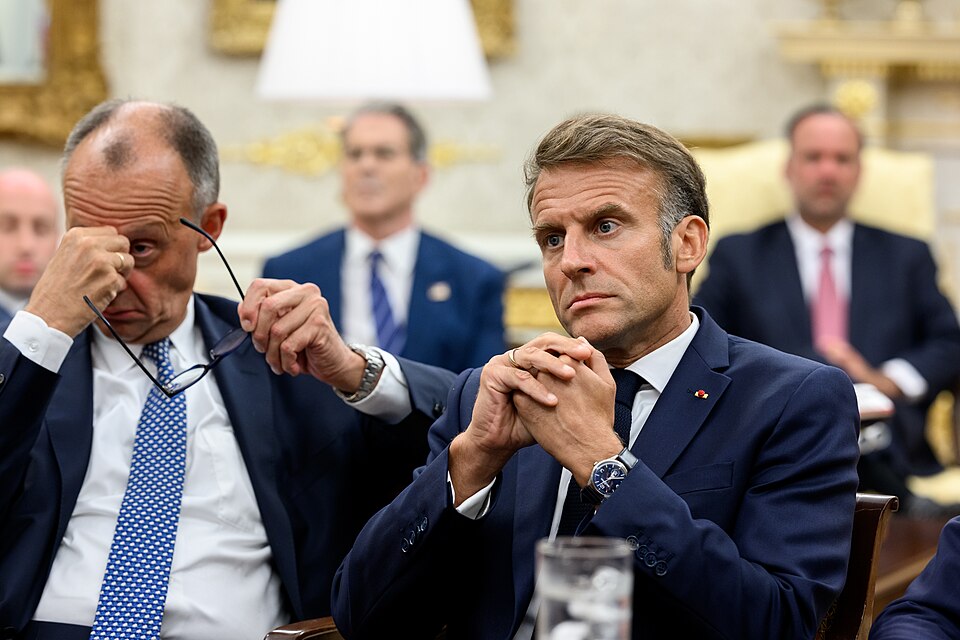
Criticizing Russian sabotage operations, Sikorski said it was particularly “vile” to involve Ukrainians in such actions, fueling hostility toward them. He concluded that Russian President Vladimir Putin is still unwilling to pursue a just peace in Ukraine and seeks Kyiv’s capitulation. Sikorski reaffirmed Poland’s support for Ukraine’s sovereignty, urging Europeans to maintain long-term backing. Photo by The White House, Wikimedia commons.