










The European Parliament marked International Holocaust Remembrance Day on Tuesday with a solemn ceremony in Strasbourg, centred on the testimony of Auschwitz survivor
Tatiana Bucci and a stark warning against the resurgence of antisemitism across Europe.
Opening the plenary session, European Parliament President Roberta Metsola reminded lawmakers that 27 January commemorates the liberation of the Auschwitz Nazi concentration camp in 1945. In a speech that linked history with present-day challenges, Metsola cautioned that antisemitism is once again gaining ground, particularly online.
“Today, antisemitism spreads faster than ever, amplified online and turning old lies into deadly realities,” she said. “Remembering the Holocaust means confronting hatred wherever it appears — before it is allowed to take root again. Because if ‘Never Again’ is to mean anything at all, it has to guide the choices we make today and the Europe we choose to build together.”
Her remarks were followed by a musical performance of Beautiful That Way by Oscar-winning composer Nicola Piovani, performed by Israeli singer Noa, setting a reflective tone for the ceremony.
At the heart of the commemoration was the address by Tatiana Bucci, who shared her childhood memories of deportation and survival. Bucci recounted how she, her sister Andra, their cousin Sergio, and other members of their family were deported to the Auschwitz-Birkenau concentration camp in March 1944.
Only six years old at the time, Bucci described how being mistaken for twins with her sister helped save their lives. Along with Sergio, the children spent ten months in Birkenau. “I got used to that life immediately,” she told MEPs. “I understood that I was Jewish by listening to our guards talk, and that we Jews were meant to have that life — which was not life, but death.”
The sisters narrowly escaped death a second time when a camp guard warned them not to respond to a call asking who wished to reunite with their mothers. They passed the warning to Sergio, who could not resist answering. He was transferred to another camp, subjected to medical experiments, and later killed. Bucci described his death as “brutal”, saying he was “hung on butcher’s hooks”.
After the camp’s liberation, Tatiana and Andra were sent to an orphanage in England before finally reuniting with their parents in Italy in December 1946. Bucci recalled a haunting moment after their return to Rome, when the sisters were shown photographs of children in the hope they could identify survivors. She later realised the images were of children murdered following the 1943 Nazi raid on Rome’s Jewish ghetto.
“Since then, and especially in these times we live in today, I hope that all children in the world can have the life I was able to live after the war and grow old as I have,” Bucci said. Despite everything she endured, she ended her testimony with a message of resilience: “Life is beautiful.”
Following her speech, Members of the European Parliament observed a minute’s silence. The ceremony concluded with a performance of ‘Kaddish’ by Maurice Ravel, underscoring the day’s message of remembrance and reflection.
About Tatiana Bucci
Tatiana Bucci was born in 1937 in Fiume, then part of Italy and now located in Croatia. She was six years old when she and her four-year-old sister Andra were deported to Auschwitz on 4 April 1944 alongside their mother, aunt, grandmother and cousin. The sisters are among the youngest child survivors of Auschwitz who retain memories of the camp.
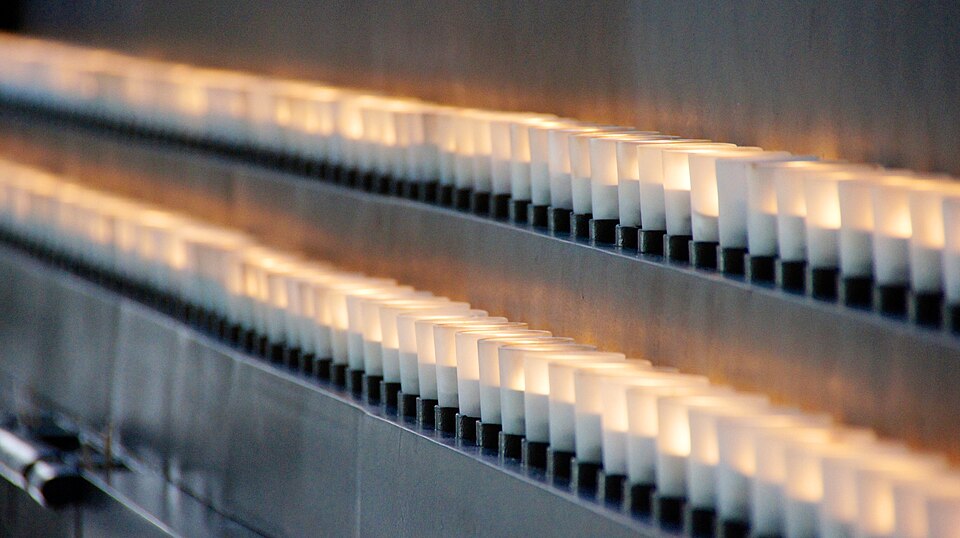
Reunited with their parents in Italy in 1946, the sisters returned to Auschwitz for the first time in 1996. Tatiana Bucci now lives in Belgium with her family. Photo by Ted Eytan, Wikimedia commons.