








French voters headed to the polls on Sunday to elect mayors across the country in a nationwide local election widely seen as an early political test before the 2027 presidential
race. Polling stations opened at 8 a.m. and were set to close at 8 p.m., with the first preliminary results expected shortly afterward. In many medium and large cities, however, the contest is likely to extend to a decisive second round scheduled for March 22.
The elections will determine leadership in nearly 35,000 municipalities — from major urban centers to tiny rural villages — making the vote one of the largest democratic exercises in the country. While municipal elections traditionally focus on local issues, analysts say the results could provide valuable clues about national political trends ahead of next year’s presidential vote.
Early turnout suggested limited enthusiasm among voters. By midday, participation stood at about 19%, only slightly higher than the 2020 local elections held during the COVID-19 pandemic and below the 23% recorded in 2014.
A key test for the far right
Much of the national attention is focused on the performance of the far-right National Rally (RN), which has historically struggled to convert national popularity into local power.
This year, the party has fielded candidates in several hundred municipalities and hopes to secure victories in a handful of significant cities — wins that could strengthen its position ahead of the presidential campaign.
One of the most closely watched races is in Marseille, France’s second-largest city, where RN candidate Franck Allisio is polling neck-and-neck with Socialist incumbent Benoit Payan. A victory there would mark a major breakthrough for the party.
“If the people of Marseille make a brave choice, it will encourage the French as they prepare to decide their future next year,” Allisio said during the campaign.
At a polling station in the city, Serge, a 61-year-old construction worker who declined to give his surname, said he did not expect dramatic change regardless of the outcome.
“They’re not worse than the others,” he said of the RN. “Nothing really changes — and that’s the problem.”
Security dominates campaign
Although municipal elections often revolve around local concerns such as housing, transportation and urban development, surveys suggest that security has become the top issue for many voters — a topic central to the RN’s campaign.
Several cities are considered potential targets for the party, including Toulon in southern France and Menton on the French Riviera. In Menton, Louis Sarkozy, son of former president Nicolas Sarkozy, is running with backing from centrist political groups.
Security concerns also influenced voters in Paris. Madani Sadaoui, a 70-year-old retiree, said he supported conservative candidate Rachida Dati for mayor.
“The right stands for security, and security is lacking across France,” he said outside a polling station in the capital’s 10th district.
Alliances could shape the outcome
Beyond individual races, political observers are watching closely to see how parties align themselves between the first and second rounds of voting.
In past decades, mainstream parties have largely avoided cooperation with the far-right RN. Whether that informal political barrier holds — or weakens — could shape the final outcomes in several municipalities.
The election is also a test for France’s fragmented left. In the 2020 municipal elections, left-wing parties performed strongly in several major cities. But nationally their influence has waned, raising questions about whether they can retain key strongholds such as Paris, Nantes, Lyon and Strasbourg.
Another unresolved issue is whether traditional left-wing parties will form alliances with the more radical France Unbowed (LFI) movement in second-round contests.
Maxim Loh, a 26-year-old Paris resident, said his vote for Socialist candidate Emmanuel Grégoire reflected a desire for stability rather than political experimentation.
“I voted for continuity,” he said. “I like the bike lanes and the green spaces that have been created.”
Stakes rising before 2027
Under France’s municipal voting system, a second round is required in cities where no candidate list wins more than 50% of the vote in the first round.
While the elections are local in nature, their broader political significance is clear: the results will offer one of the first nationwide indicators of public sentiment before the April 2027 presidential election.
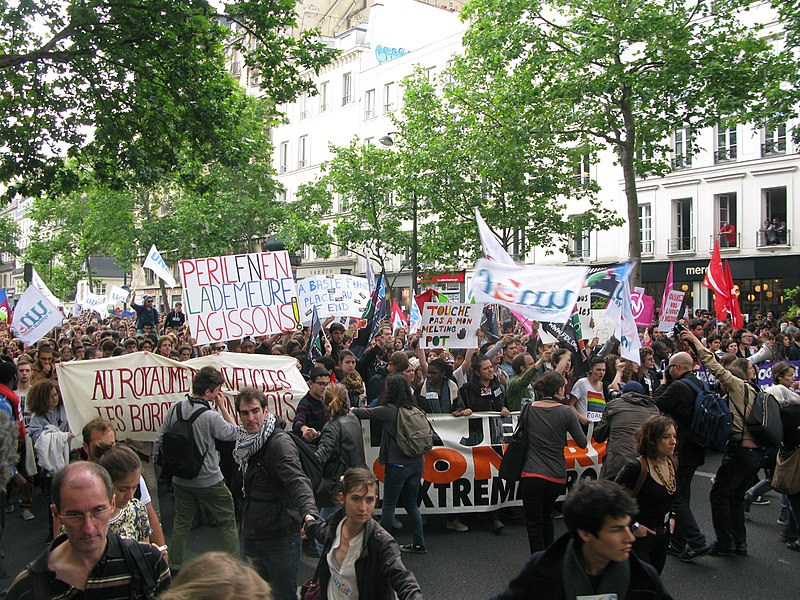
“People want to turn the page,” said Louis Aliot, the RN mayor of Perpignan. “And they want to turn it with us.” Photo by Jiel Beaumadier, Wikimedia commons.