









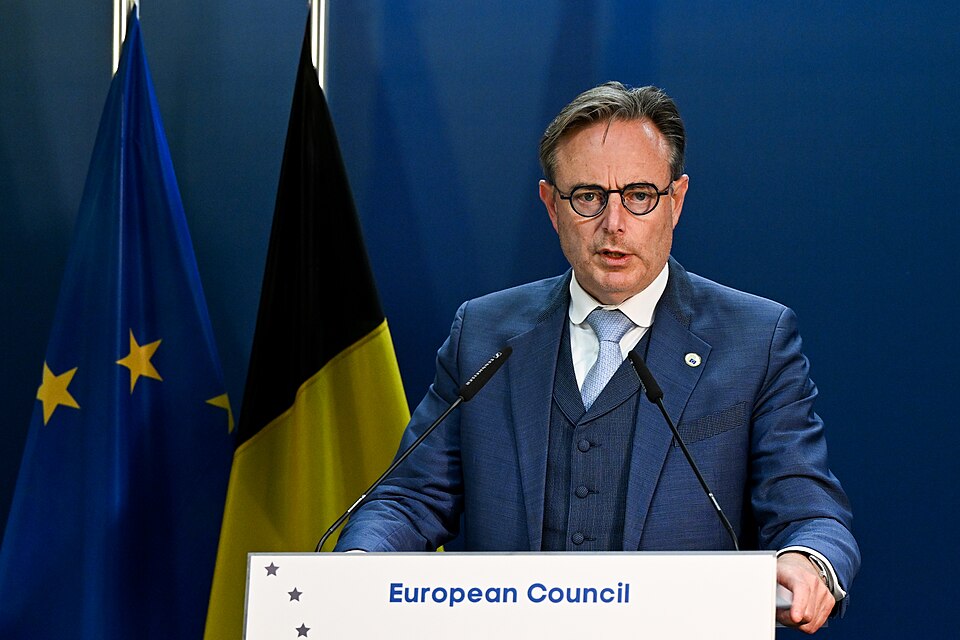
Belgian Prime Minister Bart De Wever has used the milestone of his first year in office to sharpen his message on Europe’s economic future, arguing that competitiveness and
cooperation must now move to the centre of EU policymaking.
Speaking at the presentation of his new book *Over Welvaart* (*On Prosperity*), De Wever struck a pragmatic tone, brushing aside questions about personal fulfilment. “Whether I enjoy the job is irrelevant,” he said. “What matters is that we are moving in the right direction.”
Over the past year, De Wever’s government has taken politically sensitive steps to rein in public finances, including limiting unemployment benefits and launching pension reforms. But he made clear that the work is far from complete, warning that Belgium’s budgetary challenges still require tough decisions. “The budget repairs are not finished,” he said.
Looking beyond Belgium’s borders, De Wever framed Europe as facing a decisive moment. With major EU industry gatherings scheduled in Antwerp and Alden Biesen in the coming weeks, he is calling for deeper European integration, a stronger common defence industry and broader free trade agreements. In a global landscape dominated by the United States and China, De Wever argued that Europe can no longer afford fragmentation, describing the current geopolitical climate as an “age of empires”.
At the heart of his vision is a renewed push for Benelux cooperation. By better aligning ports, labour markets and infrastructure across Belgium, the Netherlands and Luxembourg, De Wever believes the region could emerge as a powerful economic hub within Europe.
He also advocated closer ties with neighbouring regions, particularly Germany’s North Rhine-Westphalia, suggesting that stronger cross-border alliances could help counterbalance France’s influence inside the EU.
De Wever was openly critical of France’s dominant role in flagship European industrial projects, including plans for a future European fighter jet. “That is not the Europe I dream of,” he said, calling instead for broader participation and shared decision-making among member states.
As he enters his second year as prime minister, De Wever is positioning himself not just as a domestic reformer, but as a vocal advocate for a more competitive, more coordinated Europe. Photo by © European Union, 1998 – 2026, Wikimedia commons.